Consumer Behaviour: Vegemite

Australia’s Perception of Vegemite

Are you even Australian if you don’t like Vegemite? 

If you live in Australia, there no doubt that you don’t already know of Vegemite. Vegemite is a staple in most Australian households, a savoury icon. Vegemite spread can be enjoyed in many ways; in spaghetti, with avocado on toast, in cheese scrolls and many more creative ways!  

Vegemite as a company has enlisted various long-term marketing strategies in order to stay relevant. Over time, Vegemite has gone from being perceived as a simple sandwich spread to a true-blue Aussie icon. The Vegemite brand engages their consumers through appealing to their sensory systems to create a competitive advantage. This is known as sensory marketing where a brand engages consumers’ senses to influence their perception, judgement and behaviours (Solomon,2019). 

Marketers create meanings on the visual channel through a product’s colour, size and styling. (Solomon,2019) The packaging design of Vegemite consists of predominately yellow and red. The combination of yellow and red interprets happiness and excitement and grabs consumers’ attention to the product. The store design also contributes to the visual channel, of where vegemite is strategically positioned in eyes sight of consumers. 

When we think of Vegemite, the sound of the famous 1950s ‘Happy little vegemite’ jingle campaign comes to mind. This iconic and memorable campaign reminded consumers of the role Vegemite has played in the homes of Aussies for generations. This fun and uplifting jingle has since been re-worked into later Vegemite campaigns including the ‘Start Happy With Vegemite’ to re-engage and remind Australians that Vegemite, is rich in B Vitamins and can be an important part of a balanced breakfast in Australia (Samios 2017). According to the Australian food history timeline, research conducted has suggested that ‘those who regularly ate vegemite, which is rich in B vitamins, reported lower anxiety and stress scores’ furthermore emphasising the fact that we are in fact ‘happy little Vegemites’ after consuming (Australian Food History Timeline, 2019). 

“Happy Little Vegemites” 1950s Australian Commercial
Start Happy with Vegemite’ Australian Commercial

Advertising can affect our sense of taste. Researchers have shown that using a multisensory strategy that taps into taste, touch and smell will result in better taste perceptions than one that empathises taste alone (Solomon,2019). Vegemite exhibits these attributes through its  salty, thick textured, dark spread that consumers lovingly put on toast and butter that is fuelled with B vitamins, all of the aforementioned attributes appeal to consumer’s smell, touch and taste. 

Overall, Vegemite has done a great job by employing the use of long-term marketing techniques across generations to make us all ‘Happy Little Vegemites’. Personally, I have always been a lover of Vegemite, and cannot remember a time that it hasn’t been in my kitchen. I’ve always perceived the brand to be a fun and cheerful true Aussie icon. Many people will have shared memories of their parents, grandparents or families making them Vegemite sandwiches as children. As we get older, we will share that same experience with our own families. In this way, Vegemite is perceived as being more than just a mere spread but is embedded in consumer’s memories. 

References 
Solomon, M, Russell-Bennett, R. and Previte, J, 2019, ‘Consumer Behaviour’, Australian Edition, 4th Ed., Pearson
Samios. Z, 2017, ‘Vegemite aims to inspire new breakfast meals in latest campaign’, Mumbrella, viewed 1 April 2019
Available at: https://mumbrella.com.au/vegemite-inspires-new-breakfast-meals-latest-campaign-429728
Australian Food History Timeline, 2019, ‘1954 Happy Little Vegemite’s Jingle’, Australian Food History article, n.d., accessed 13thMay, available at: https://australianfoodtimeline.com.au/happy-little-vegemites/

Vegemite and Classical Conditioning

Do we actually like the taste of Vegemite? Or are we just conditioned to like the brand and ritual of eating it?

How a brand is remembered is very important to the success of a brand or a product. The goal of the marketer when it comes to learning is to strategically place their brand in the mind of consumers, ideally their long-term memory. Everyday consumers are exposed to thousands of brands and are able to recognise these brand names and hum to many product jingles, even for products they themselves do not use. This casual unintentional acquisition of knowledge is known as incidental learning(Solomon,2019). For marketers to therefore effectively cement their brand into the minds of consumers they will need to employ several different models of learning that are broken down into two types: Behavioural and Cognitive learning theories.

Behavioural Learning Theories focus on learning as a response to external events. (Solomon, 2019) A major behavioural learning theory adopted by marketers is the Black Box Theory. This theory underlines the study of consumer buying behaviour using two approaches: Classical Conditioning and Instrumental Conditioning.

Many people have a strong passion for Vegemite and view it as a uniquely Australian food. Yet, they couldn’t tell you when they started eating it, or why they like it. This is due to the ways in which Vegemite has marketed their products. Through countless campaigns, Vegemite has conditioned consumers into associating Vegemite with Australia. 

An Australia Day message from Vegemite brand

The brand Vegemite has embraced a classical conditioning approach in their advertisements throughout the years to create connection between Vegemite and Australian culture. Classical Conditioning achieves a positive outcome through the combination of two different stimuli formulating a new meaning (Johnston 2012).Thus, by incorporating celebrities and public figures (Aussie legends so-to-speak) in their advertisements, Vegemite have been able to direct the positive emotion to their brand image. Seeing your favourite actor on television with a jar of Vegemite elicits a strong response therefore encouraging you to turn the toaster on and slather vegemite and butter across a crispy slice of fresh toast. Australian celebrity, Hugh Jackman, on the Jimmy Fallon Tonight Show, argued that foreigners don’t know how to eat Vegemite properly therefore that is why they are not fans of the famous salty snack. Eating Vegemite is seen as an ‘art’ and proper science unique to Australia. However, unlike foreigners, Australians have been conditioned to repeat this ‘artform’ since childhood. Since growing up, now eating vegemite as adults, we associate it with nostalgic moments of milo and vegemite after school or eating it for breakfast as children.

Hugh Jackman sharing his love of Vegemite with Jimmy Fallon and “shows him how to really eat Vegemite”
‘Tastes Like Australia’ Vegemite Campaign

Vegemite uses repetition in their advertising campaigns in the form of colour, consistent themes and the same phrase repeated over and over again. The consistent use of bright golden yellow background and classic red logo has been shaped as one of Australia’s most iconic features and this has been represented consistently throughout all their advertising material and product packaging. Throughout all their advertisements they repeat the happy and energetic Aussie iconic theme, to promote Vegemite as a universal Aussie household staple, that is rich in Vitamin B to keeping you going all week long. Vegemite has further embedded their brand into the minds of consumers through the classic 1950s jingle “Happy Little Vegemite”. Sager (2016) states that jingles are an effective way to get your brand locked into a consumer’s brain, a study conducted from the University of Vienna stated that 89% of participants in a study from claimed that they considered jingles to be a highly effective form of advertising. The song has become an anthem for the Vegemite brand and has being reinforced throughout later campaigns. Many Australians are familiar with the songs phrases such as “it puts a rose in every cheek” and are able to make a direct connotation between the phrases from the song with the brand. This is a perfect example of how repetition of the same themes or phrases can prove to be effective in conditioning consumers and making them remember what Vegemite means to Australia. 

The ability for Vegemite to successfully position their brand into an Australian consumer’s long-term memory is reflective in how there is a strong connection between Vegemite and Australian culture. 

References 

Vegemite Personality and Self-Concept

How do you like your Vegemite?

Brand personality and positioning play important roles in the success of brands. The concept of personality refers to a person’s unique psychological make up and how it consistently influences the way they respond to their environment (Solomon, Russell-Bennett & Previte 2019). The fundamental of brand personality is that consumers will buy brands/products that has a brand personality similar to their own individual personality (Solomon, Russell-Bennett & Previte 2019). There are different self-images that play a large role in this process of developing and applying self-concept to purchases we make. 

Have you ever scrolled through your social media feeds and come across online quizzes that ask you information on “favourite colour” to anything from “What spirit animal are you?”. These smart online quizzes draw us in to determine our type of behaviour we represent. Thus, marketing efforts aim to capitalise on consumer’s desire to be seen a certain way socially and convince them that their product is a key factor in achieving the self-image they desire. 

Vegemite is a product that holds a strong brand personality with Australian culture. Personally, I cannot remember a time that Vegemite has not been found in my kitchen. I myself am a Vegemite lover however, I wouldn’t say that I eat it frequently more so rather it is a household staple food that satisfies my salty cravings with its lovesome, thick dark spread. I’ve always perceived the brand to be a fun and cheerful true Aussie icon and believe the Vegemite brand personality holds traits such as tradition, comfort and success. 

However, the Vegemite brand has had a few backlashes against its brand personality throughout its lifetime, the brand hadn’t always been Australian owned for the majority of its life. Until 2017, Vegemite had been owned by a range of global organisations outside of Australia, however was brought home when Bega Cheese was able to strike a deal (The Guardian 2017). One must consider how the ownership has affected the brand personality of Vegemite. The Truly Deeply blog features an article on this topic and gives insight into how the brand personality traits of tradition and success may be possibly hindered as a result, because the success for not really made initially in Australia. The link between this issue and Vegemite’s brand personality is fairly loose and probably a debateable point because of how closely tied the brand is in Australian culture. Furthermore, people in Australia may have different perceptions of Vegemite or different views on what it means to them. However, one thing that is undeniable is that the product itself is indeed Australian. 

Research undertaken by Kraft and IBM in 2008 revealed that most consumers had a strong passion for Vegemite and a unique way of eating it. In an effort to make it more relevant, Vegemite went to ask: How do you like your Vegemite? 

2008 Vegemite Census conducted by Kraft and IBM research

The research was undertaken to understand the various ways that people love Vegemite. It was called the ‘Vegemite Census’ in its 2008 release by IBM. Kraft marketed this ‘How do you like your Vegemite?’ campaign, with the idea claiming that the way you ate your Vegemite reflected your personality type. The main categories which they sorted this census into are outlined below:
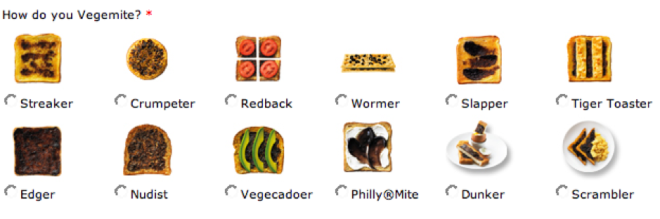
How Do You Like Your Vegemite – Personality Reflections:

The Edger 
Always very particular about their Vegemite, they like it spread right to the crust. Probably has a very neat kitchen too. Somewhat of a perfectionist. 

The Streaker 
Doesn’t like having much on. Vegemite, that is. Gives the toast just a couple of light streaks of Vegemite. Too frugal, they don’t realize you can never have too much of a good thing. 

The Vegecadoer 
Health fanatic, this person thinks the saying ‘eat your greens’ means with every meal. So, their morning slice of Vegemite toast gets adorned with creamy slivers of fresh avocado. Probably jogs a half marathon in the morning too. These people tend to inspire jealousy. 

The Dunker 
Cuts Vegemite toast into soldiers which are then lowered slowly into a hot and gooey pool of boiled googie- egg. Once they’re nicely coated in yellowy goodness, the soldiers are sent to meet their maker. This person may have a wicked sense of humour. 

The Wormer 
Can’t grow up. Still likes watching the squiggly Vegemite worms appear through the holes in the Premium biscuits. Playful characters, these people squeeze the most out of life. 

The Slapper 
Loose with the way they apply their Vegemite, it’s slapped on like a brickie with a trowel. Could indicate this person is particularly disorganised, probably shows they’re just in a hurry to eat breakfast. They relish the fact that every mouthful is a surprise. 

The Tiger Toaster 
Not quite on the endangered list, but still not a lot of them about. They love strips of bubbling, grilled cheese layered over their Vegemite. Very organised and patient, they are prepared to lay in wait for their meal. Like a tiger. 

The Nudist 
The purist of all Vegemite eaters. No butter. No marg. Just a piece of toast and the world’s mightiest spread. What more do you need? They are Zen-like and remain calm under pressure. 

The Crumpeter 
Saying ‘no’ to convention, they prefer crumpets over toast. Likes to watch black holes forming as the Vegemite melts away into the crumpet’s craters. Definitely likes to think outside the square. 

The Philly®Mite 
Worldly types, these people marry the creamy richness of Philadelphia Cream Cheese with good ol’ Aussie Vegemite to create an extravagant taste combination. Like to indulge themselves. 

The Redback 
Can’t decide whether they want a salad or breakfast, Redback eaters do both with a couple of sweet, juicy tomato slices on their Vegemite toast. Not wanting to miss out on anything, they go for both sweet and savoury. 

The Scrambler 
This person greets the new day with a big, golden pillow of deliciously fluffy scrambled egg placed ever so lovingly next to two triangles of Vegemite toast for a melt in the mouth taste sensation. Scrambled by name, not by nature. 
(Campaign Brief, 2008)

Can you find which one are you? And do you believe it’s a relevant description of your personality? 

The results of the research findings discovered that there were three core ways people eat Vegemite, Streaker (38%), Slapper (13%), & Nudist (10%) (Campaign Brief, 2008). Overall, the campaign provided a very interesting assessment of how companies can use self-concept and personality traits to market a product.

Consumer self-image is a crucial area for brand’s to understand to best ensure their marketing efforts have leave a meaningful impression on consumers and is essentially the basis of consumer research into personality. The way we see ourselves and the way we wish to be seen is of huge importance to all of our decision making and is significant in the products we choose to buy, which is why brand’s pay such close attention to making sure they make use of their target market’s self-image.

Vegemite Lover

References 


Motivation behind Vegemite

What drives us to buy a new outfit, upgrade our mobile phones or eat at that 5-star restaurant? The idea that people buy things in terms of their functionality or in terms of what they mean relating to their symbolism is part of understanding consumer motivation. 

Motivation is the process that leads individuals to behave as they do, and it occurs when a need is triggered that the customer wishes to satisfy (Solomon, Bennett and Previte 2019).Once a need has been activated, a state of tension exists that drives the consumer to attempt to reduce or eliminate the need (Solomon, Bennett and Previte 2019). This is where marketing has real power in the idea of creating tension and drive referring to how marketers’ present their products to be attractive and likely to succeed in achieving the consumer’s particular goal better than other brands. This is achieved through a range of marketing activities such as selection of celebrity endorser and sales promotions, all of which capture the consumer’s attention and activate them to take action and perform desired behaviour. Marketers ability to influence tension and drive ultimately heightens consumers desires and lead them towards their brand. There are theories surrounding this topic, to help us understand the motivations behind decisions.

There are two theories of motivational strength – the Drive and Expectancy theory (Solomon, Bennett and Previte 2019). The Drive theory refers to the biological needs leading to an unpleasant state of arousal (Solomon, Bennett and Previte 2019). In Vegemite’s case, the brand satisfies the unpleasant state of hunger. Vegemite has a rich history dating back to WWII, when the troops were given Vegemite to satisfy hunger – this resulted in Vegemite being rationed throughout the households of Australia, to meet demand – and from then onward has had a considerable market position (Vegemite 2019). Furthermore, Vegemite’s characteristics of lowered price and quick preparation time allows for a lot of tension release within the consumer. The tension of time and money are lessoned because Vegemite is very affordable and fast to prepare, all you need is a slice of bread and you’re good to go or you can even eat it straight from the jar if you’re really time poor! 

The Expectancy theory refers to the way consumers behave in a certain way as they believe by choosing one product over another because they expect this choice to achieve a higher positive outcome (Solomon, Bennett and Previte 2019).This comes into play when consumers are choosing between Vegemite and another breakfast spread such as Nutella or Peanut butter etc. The aspect of health and feeling good will lead many consumers to choose Vegemite because of its B-vitamin content and lower calorie content and they expect Vegemite will make them feel better over other higher content breakfast spread alternatives.

References

  • Solomon, M, Russell-Bennett, R. and Previte, J, 2019, ‘Consumer Behaviour’, Australian Edition, 4th Ed., Pearson

Personality & The Self

Brand personality and positioning play important roles in the success of brands. The concept of personality refers to a person’s unique psychological make up and how it consistently influences the way they respond to their environment (Solomon, Russell-Bennett & Previte 2019). The fundamental of brand personality is that consumers will buy brands/products that has a brand personality similar to their own individual personality (Solomon, Russell-Bennett & Previte 2019). There are different self-images that play a large role in this process of developing and applying self-concept to purchases we make. 

Have you ever scrolled through your social media feeds and come across online quizzes that ask you information on “favourite colour” to anything from “What spirit animal are you?”. These smart online quizzes draw us in to determine our type of behaviour we represent. Thus, marketing efforts aim to capitalise on consumer’s desire to be seen a certain way socially and convince them that their product is a key factor in achieving the self-image they desire. 

Vegemite is a product that has a strong cemented brand personality particularly within Australian culture. Personally, I cannot remember a time that Vegemite has not been found in my kitchen. I myself am a Vegemite lover however, I wouldn’t say that I eat it frequently more so rather it is a household staple food that satisfies my salty cravings with its lovesome, thick dark spread. I’ve always perceived the brand to be a fun and cheerful true Aussie icon and believe the Vegemite brand personality holds traits such as tradition, comfort and success. 

However, the Vegemite brand has had a few backlashes against its brand personality throughout its lifetime. In particular, its longest running issue until recently was that the brand hadn’t always been Australian owned for the majority of its life. Until 2017, Vegemite had been owned by a range of global organisations outside of Australia, however was brought home when Bega Cheese was able to strike a deal (The Guardian 2017). The Truly Deeply blog features an article on how the ownership has affected the brand personality of Vegemite, possibly hindering the traits of tradition and success, because the success was not really made by an Australian company. The link between this issue and Vegemite’s brand personality is fairly loose and probably a debateable point because of how closely tied the brand is in Australian culture. Furthermore, people in Australia may have different perceptions of Vegemite or different views on what it means to them. However, one thing that is undeniable is that the product itself is indeed Australian. 

Consumer self-image is a crucial area for brand’s to understand to best ensure their marketing efforts have leave a meaningful impression on consumers and is essentially the basis of consumer research into personality. The way we see ourselves and the way we wish to be seen is of huge importance to all of our decision making and is significant in the products we choose to buy, which is why brand’s pay such close attention to making sure they make use of their target market’s self-image.


References 

My Love of Vegemite

Learning and Memory

How a brand is remembered is very important to the success of a brand or a product. The goal of the marketer when it comes to learningis to strategically place their brand in the mind of consumers, ideally their long-term memory. Everyday consumers are exposed to thousands of brands and are able to recognise these brand names and hum to many product jingles, even for products they themselves do not use. This casual unintentional acquisition of knowledge is known as incidental learning(Solomon,2019). For marketers to therefore effectively cement their brand into the minds of consumers they will need to employ several different models of learning that are broken down into two types: Behaviouraland Cognitive learning theories.

Behavioural Learning Theories focus on learning as a response to external events. (Solomon, 2019) A major behavioural learning theory adopted by marketers is the Black Box Theory. This theory underlines the study of consumer buying behaviour using two approaches:

  • Classical Conditioning
    • Repetition – process of pairing conditioned stimulus and unconditioned stimulus repeatedly.
    • Stimulus Generalisation – process that occurs when the behaviour caused by a reaction to one stimulus transfers to another stimulus.
    • Stimulus Discrimination – process that occurs when consumers learn to differentiate a stimulus from other similar stimuli.
  • Instrumental Conditioning
    • Positive reinforcement – rewards provided by the environment strengthen responses to stimuli and appropriate behaviour is learned.
    • Negative reinforcement – environment weakens responses to stimuli so that inappropriate behaviour is avoided.
    • Punishment – the learning that occurs when a response is followed by unpleasant events.
      (Solomon,2019)

Classical Conditioning achieves a positive outcome through the combination of two different stimuli formulating a new meaning (Johnston 2012). The main aim of Classical Conditioning is for marketers to get consumers to associate their product with a particular feeling or response.

The brand Vegemite has embraced a classical conditioning approach in their advertisements throughout the years to create connection between Vegemite and Australian culture. By incorporating celebrities and public figures (Aussie legends so-to-speak) in their advertisements, Vegemite have been able to direct the positive emotion to their brand image. Seeing your favourite actor on television with a jar of Vegemite elicits a strong response therefore encouraging you to turn the toaster on and slather vegemite and butter across a crispy slice of fresh toast. 

Image result for gif of celebrity with vegemite
Hugh Jackman sharing his love of Vegemite with Jimmy Fallon


Vegemite Advertisement “Tastes Like Australia”

Vegemite uses repetition in their advertising campaigns in the form of colour, consistent themes and the same phrase repeated over and over again. The consistent use of bright golden yellow background and classic red logo has been shaped as one of Australia’s most iconic features and this has been represented consistently throughout all their advertising material and product packaging. Throughout all their advertisements they repeat the happy and energetic Aussie iconic theme, to promote Vegemite as a universal Aussie household staple, that is rich in Vitamin B to keeping you going all week long. Vegemite has further embedded their brand into the minds of consumers through the classic 1950s jingle “Happy Little Vegemite”. Sager (2016) states that jingles are an effective way to get your brand locked into a consumer’s brain, a study conducted from the University of Vienna stated that 89% of participants in a study from claimed that they considered jingles to be a highly effective form of advertising. The song has become an anthem for the Vegemite brand and has being reinforced throughout later campaigns. Many Australians are familiar with the songs phrases such as “it puts a rose in every cheek” and are able to make a direct connotation between the phrases from the song with the brand. This is a perfect example of how repetition of the same themes or phrases can prove to be effective in conditioning consumers and making them remember what Vegemite means to Australia. 

“Happy Little Vegemites” Jingle

The ability for Vegemite to successfully position their brand into an Australian consumer’s long-term memory is reflective in how there is a strong connection between Vegemite and Australian culture. 

References 

Sensory Marketing – Vegemite

If you live in Australia, there no doubt that you don’t already know of Vegemite. Vegemite is a staple in most Australian households, a savoury icon. Vegemite spread can be enjoyed in many ways; in spaghetti, with avocado on toast, in cheese scrolls and many more creative ways!  

The Vegemite brand has a history spanning over 90 years. In 1922 when the Fred Walker Company, which would later become Kraft Food Company, hired a young chemist to develop a spread from one of the richest known natural sources in the Vitamin B group – brewer’s yeast. After a nation-wide naming competition, Walker’s daughter selected the winning name – VEGEMITE. (Vegemite, 2019) 

The Vegemite brand engages their consumers through appealing to their sensory systems to create a competitive advantage. This is known as sensory marketing where a brand engages consumers’ senses to influence their perception, judgement and behaviours.(Solomon,2019)

Related image

Marketers create meanings on the visual channel through a product’s colour, size and styling. (Solomon,2019) The packaging design of Vegemite consists of predominately yellow and red. The combination of yellow and red interprets happiness and excitement and grabs consumers’ attention to the product. The store design also contributes to the visual channel, of where vegemite is strategically positioned in eyes sight of consumers. 

When we think of Vegemite, the sound of the famous 1950s ‘Happy little vegemite’ jingle campaign comes to mind. This iconic and memorable campaign reminded consumers of the role Vegemite has played in the homes of Aussies for generations. This fun and uplifting jingle has since been re-worked into later Vegemite campaigns including the ‘Start Happy With Vegemite’ to re-engage and remind Australians that Vegemite, is rich in B Vitamins and can be an important part of a balanced breakfast in Australia. (Samios 2017)

‘Happy Little Vegemite’ 1950s Australian Commercial
‘Start Happy with Vegemite’ Australian Commercial

Advertising can affect our sense of taste. Researchers have shown that using a multisensory strategy that taps into taste, touch and smell will result in better taste perceptions than one that empathises taste alone (Solomon,2019). Vegemite exhibits these attributes through its  salty, thick textured, dark spread that consumers lovingly put on toast and butter that is fuelled with B vitamins, all of the aforementioned attributes appeal to consumer’s smell, touch and taste. 

Personally, I have always been a lover of Vegemite, and cannot remember a time that it hasn’t been in my kitchen. I’ve always perceived the brand to be a fun and cheerful true Aussie icon. 

References 
Solomon, M, Russell-Bennett, R. and Previte, J, 2019, ‘Consumer Behaviour’, Australian Edition, 4th Ed., Pearson
Vegemite, 2019, ‘The Vegemite Story’, Vegemite Australia, viewed 1 April 2019
Available at: https://vegemite.com.au/heritage/the-vegemite-story/
Samios. Z, 2017, ‘Vegemite aims to inspire new breakfast meals in latest campaign’, Mumbrella, viewed 1 April 2019
Available at: https://mumbrella.com.au/vegemite-inspires-new-breakfast-meals-latest-campaign-429728

Decisions, Decisions, Decisions.

The consumer market is constantly changing, with new products and brands emerging every day. For many, the decisions associated with buying a new product can be a daunting process as the sheer amount of choices can be overwhelming. 

When selecting which product to buy many of us allow ourselves to get caught making decisions out of habit or selecting the most heavily advertised product. Ideally people prefer to make shopping for a new product as convenient as possible and will often fall back on preconceived notions based on word of mouth from our social groups or information, we have gathered through marketing material. 

When we choose to go down the road of convenience and avoid conducting any independent research, we run the risk of buying a product that is not best suited to our needs or we may lose money by not purchasing the best value product. Therefore, prior to  purchasing any product a consumer will go through an extensive decision-making process. 

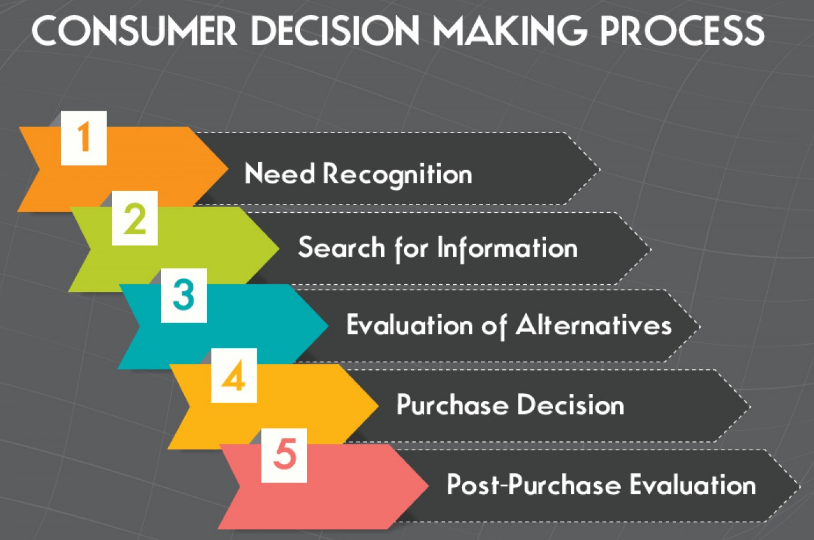
Recently this week I have found myself having to make an important lifestyle decision on what car to buy after a roller-coaster week of car problems and stress. To me, selecting which brand and type of car to buy is considered as an extended problem-solving behaviour as it requires extensive time spent information gathering and deliberation. There are five stages in the consumer decision-making process. 

  1. Problem Recognition is when there is a significant difference between an actual and an ideal state. The problem for me was that I needed a new car to well be able to actually attend this class and for daily use.
  2. Information search is where the consumer will begin to seek data in order to identify different product options. I have begun in-depth research for potential brands that would be suitable to my criteria which have to meet the balance between value, reliability, comfort. I have also consulted with friends and family for advice on car brands that they believe as well to have a long-standing reputation of producing safe and reliable vehicles.
  3. Evaluation of alternatives refers to when the consumer will weigh up the benefits of products compared to others based on the criteria, they have established for themselves. The alternatives that are actively considered in a consumer’s choice process are called their evoked set. Toyota, Mazda and Hyundai are brands that form my evoked set. The inert set is comprised of products that are not top-of-mind but could be considered. Isuzu, Nissan and Mitsubishi. Brands that you would never consider make up our inept set. Holden falls in my inept set as I have had negative product quality experiences with the brand, hence the need to conduct this particular decision-making process right now… 
  4. Product choice stage refers to after all the options have been considered the consumer can make a choice that is most relevant to them. I decided to purchase a Toyota Corolla because they are compact yet spacious, reliable, affordable and Toyota offered me an extended warranty which is peace of mind that I will have many trouble-free years of reliable transport. 
  5. Post-purchase evaluation influence the consumer’s future relationships with the product and the brand itself. I am over the moon with my new little car as it is exactly what I needed and ticks all the boxes. I also am very pleased with Toyota and the level of service and experience they gave me. I would definitely recommend Toyota to friends and family. 

Catch me around uni in my new whip!

References

Solomon, M, Russell-Bennett, R. and Previte, J, 2019, ‘Consumer Behaviour’, Australian Edition, 4th Ed., Pearson

Martyrdom Effect

Pain and effort are two things we usually wish to avoid. When it comes to raising money for charity, however, people are surprisingly drawn to painful and effortful fundraisers such as charity marathons, spartan race or the ice bucket challenge. The face of popular fundraisers today are endurance-a-thons, the harder the fundraiser is the more compelled people are to get involved. People today are even enduring these marathons wearing ridiculous outfits and uncomfortable mascot suits just to make the experience a little more challenging. This is called the Martyrdom effect, where one who makes great sacrifices or suffers much in order to further a belief, cause or principle (Olivola,C & Shafir,E, 2011). Making charitable giving reliant on a painful and effortful experience adds “meaningfulness” and symbolic value to the donation process and to the donation itself. As a result, people donate more when fundraising is both painful and effortful.

Research conducted by Christopher Olivola and Eldar Shafir compared people’s willingness to contribute to a charity fundraiser when the donation process is easy and enjoyable compared to painful and effortful. They conducted a serval experiments to replicate their results of the martyrdom effect. Their research proved that people were more willing to participate in painful–effortful events and give away their money to aid anonymous others that have been involved in human suffering such as disease, poverty and natural 

However, this idea for people to feel better if they run a marathon at the risk of potentially injuring themselves that people are more likely to donate larger amounts to the cause if the fundraising event is challenging. The question is then asked are these painful effortful fundraisers the most efficient means to improve welfare? Can we do better by participating in something good for a good cause and being helpful in the process. For example, tree planting and garbage cleaning challenges. 

I have personally found myself to be more inclined to donate more and participate in endurance fundraisers rather than charity picnics and high tea fundraisers. Funnily enough this weekend my mum and I are participating in the Campbelltown City Challenge Walk at the Australian Botanic Gardens. My mum and I are entered the 11km race walk because as my mum says, “there’s no point waking up for 6km”. Let’s hope I don’t pull a muscle…

References
Olivola,C & Shafir,E, 2011, The Martyrdom Effect: When Pain and Effort Increase Prosocial Contributions, Wiley Journal of Behavioural Decision Making, viewed 9 March 2019
Available at: https://www.ncbi.nlm.nih.gov/pmc/articles/PMC3613749/